Most equine-assisted providers know the moment: the plan is solid, the horse is ready, and five minutes in the participant drifts—eyes down, pace spikes, or the horse mirrors the tension. You adjust the activity, add prompts, maybe get a short burst of cooperation, and still feel the session go flat.
Usually, the issue isn’t a lack of tools. It’s that the session was designed to prioritize the wrong outcome.
Sessions that truly hold attention treat engagement as the north star. Skills can grow on top of that. When you design for curiosity, relationship, and regulation—with the child, the horse, and the land all shaping the experience—things often soften: behavior steadies, communication gets clearer, and learning starts to build naturally over time.
Key Takeaway: Engagement-led equine autism sessions prioritize curiosity, regulation, and relationship over compliance, using the horse and environment as active partners. When structure, sensory needs, communication style, and real-time attunement guide choices, attention stabilizes and skills like communication and social learning develop more naturally over time.
Why Engagement Matters More Than Compliance
Lasting engagement is what gives equine sessions their depth. When a participant feels curious, connected, and regulated, they’re far more available for learning than when they’re simply following directions.
That focus on engagement also fits what we see in practice: consistent equine-assisted activities can support change across domains, with shifts that tend to build through repetition and relationship.
It also helps to remember that engagement can be quiet. Watching closely, resting a hand on the horse, tracking movement around the arena, or asking careful questions can be strong participation—even if the session doesn’t look “busy.”
The environment supports this in a special way. Horses bring movement, touch, rhythm, and immediate feedback. And the wider equine space—pathways, paddocks, wind, birdsong, changing light—often invites curiosity more naturally than indoor settings that can feel demanding or flat.
As Linda Kohanov reminds us, horses “mirror our internal landscape so clearly that avoidance becomes much harder and authentic change becomes possible” (Linda Kohanov).
Start With the Right Match: Child, Horse, and Environment
Engagement begins before anyone enters the arena. The strongest foundation comes from matching participant, horse, and environment as one whole system.
Start with a respectful strengths-and-preferences profile. Keep it practical:
- sensory likes and dislikes
- movement needs
- communication style
- special interests
- common stressors or overload cues
- what usually helps the person settle
Then match the horse with the same level of care. Especially early on, a steady horse with predictable movement often supports regulation better than one who is reactive or easily unsettled. Size, stride, energy, and tolerance for pauses can make a real difference.
Consider the land, too. Sometimes a participant engages first with the fence line, the sound of hooves on gravel, or the shape of a trail before engaging directly with the horse. That still counts—often it’s the doorway in.
Equine literacy belongs at the center of session design. Reading body language in real time—ear tilt, eye tension, a change in stride, hesitation, quickening—helps you adapt early and protect the quality of the interaction.
As Temple Grandin notes, horses can catalyze trust and empathy; their feedback on our choices is immediate and clarifying (Temple Grandin).
Use a Predictable Session Structure
Predictability supports participation. For many autistic participants, consistent rhythms reduce uncertainty and make it easier to stay present. Modern findings support the value of predictable structure for easing anxiety and distress.
A simple session arc might look like:
- arrival and orientation
- brief regulation check-in
- grooming, leading, or another warm-up
- one core mission, game, or pattern
- cool down and simple reflection
Think of structure like a safe trail map: the participant knows where they are, so they can relax into exploring. Inside that dependable container, small variations keep things lively—new obstacle lines, a different grooming role, a story prompt, a scavenger element, a change of route, or choosing between two tasks.
Visual supports can strengthen this without adding language pressure. Picture schedules, arena maps, object cues, or first-then boards make the session easier to “read.”
As one family shared, being outdoors and moving alongside horses created space for real processing without face-to-face pressure: “We could be outside, moving around, and connecting with the horses” (Arise Equine).
Choose Activities by Sensory Profile and Communication Style
Not every engaging task looks the same. Strong activity choices fit how the participant seeks input, avoids overload, organizes attention, and communicates.
For sensory seekers, organized motion and rhythm can be especially supportive. Options may include:
- trotting or rhythmic mounted patterns where appropriate
- leading through obstacle sequences
- carrying poles, buckets, or cones
- “power jobs” with a clear physical purpose
For sensory-avoidant or easily overwhelmed participants, engagement often lasts longer when they can start at a distance and approach on their own timeline. Helpful starting points include:
- watching the horse from outside the arena
- “horse detective” observation games
- brief, predictable grooming routines
- choice-based approaches with easy exits
For minimally speaking or AAC-using participants, body-based and visual routines can work beautifully. Horses rely heavily on nonverbal communication, and they often respond clearly to nonverbal signals. Pointing, pausing, offering symbols, leading, and repeating movement patterns can create genuine communication moments without forcing speech.
Across profiles, plan for waves: alternate activation with grounding. A more active task can be followed by slow brushing, quiet walking, fence-line observation, or a brief reset beside the horse. Essentially, you’re protecting regulation across the whole session instead of spending it all in the first ten minutes.
Both groundwork and mounted experiences can be valuable. Groundwork often supports choice-making and problem-solving, while mounted experiences can offer strong rhythmic input. The right balance depends on the participant, the horse, and the day in front of you.
Facilitate in Real Time, Not From a Script
Even the best plan has to stay alive in the moment. Engagement is co-created through the horse-participant relationship and the facilitator-participant relationship. Your pacing, tone, and flexibility matter as much as the activity.
When energy spikes, you might slow the pace, shorten the task, widen the distance, or shift from doing to observing. When energy drops, a clearer mission, a more physical role, or a fresh choice can bring the session back into focus.
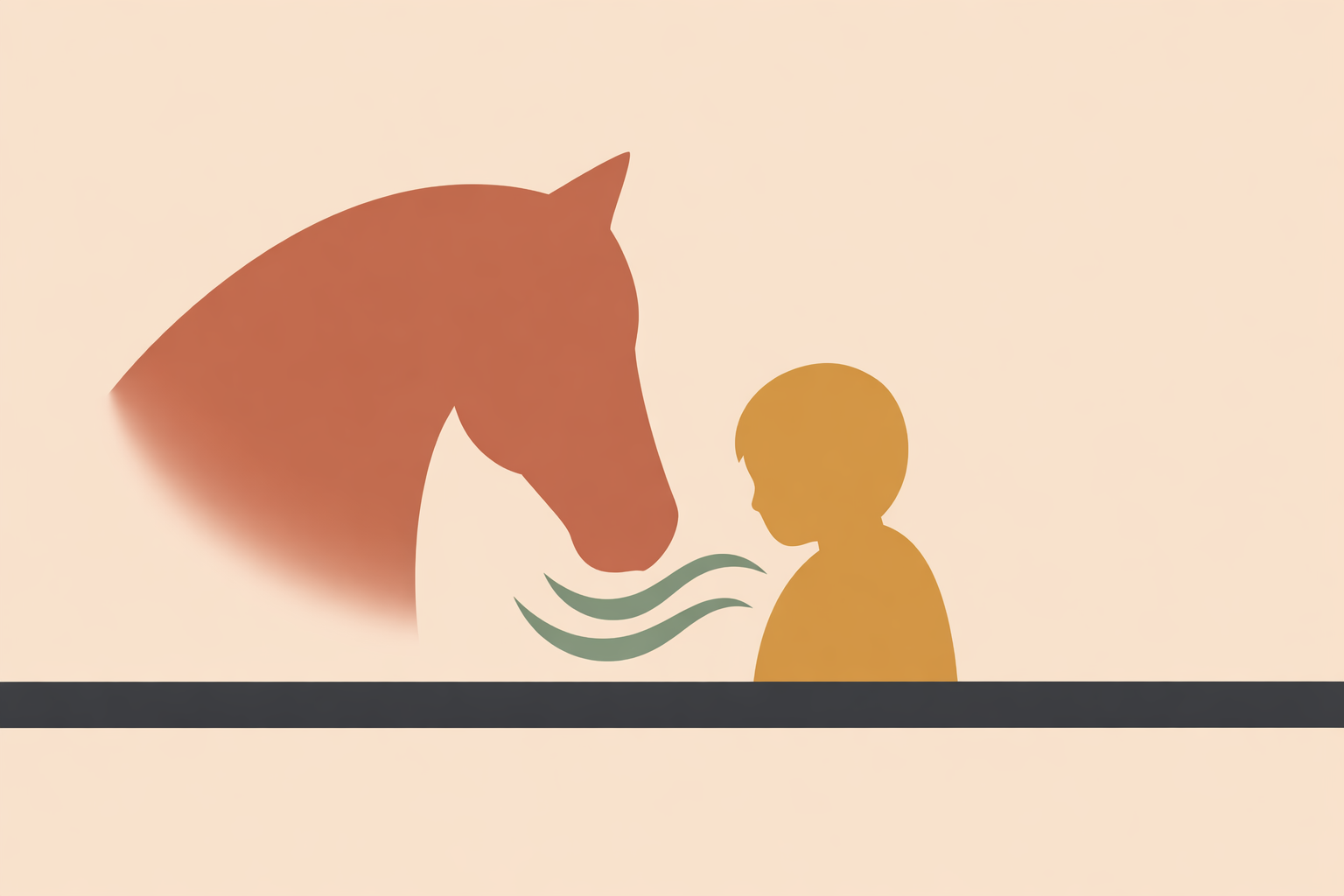
Horses often work like sensitive biofeedback. Participant tension may show up as the horse quickening, hesitating, bracing, drifting away, or looking elsewhere. Catching those changes early lets you adjust before engagement collapses.
Useful reset strategies include:
- switching roles: leader, rider, observer, helper
- moving to a quieter area
- short breathing pauses
- hand-on-heart or hand-on-withers grounding moments
- returning to a familiar task before trying again
It also helps to broaden what “success” looks like. Behavioral engagement is only one layer. Emotional and cognitive engagement matter, too—steady observation, careful listening, planning a route, remembering a sequence, or choosing when to approach.
As one participant shared, noticing how the horse changed around them made inner states like anxiety and confidence suddenly visible (Kindle Hill).
Build Communication, Social Learning, and Regulation Into the Work
The beauty of equine sessions is that skills can be woven into tasks that feel real and purposeful, not like drills.
Horse interactions create frequent, functional reasons to communicate: asking for a brush, choosing a route, offering a cue, responding to a prompt, coordinating with a helper, or explaining what the horse needs next. Structured horse programs have been linked with communication skills alongside responsibility and interpersonal growth.
The horse’s immediate responses also make cause and effect easier to feel. A shift in posture, timing, pace, or clarity can lead to a visible change in the horse. Put simply, the learning is embodied—less talk, more lived experience.
Group and dyad formats can deepen this. Shared leading, turn-taking, co-designing obstacle patterns, and collaborative problem-solving often create richer social learning than solo work alone.
Regulation can be built into the flow as well. Many practitioners use synchronized breathing, rhythmic brushing, slower walking, or returning to a calm zone as simple, repeatable ways to steady attention.
As one professional observed, experiential work lets young people share indirectly: “As long as we keep the conversation about the horses, they will often reveal what they cannot say about themselves” (experiential therapies).
Keep Ethics Visible: Horse Welfare, Neurodiversity, and Scope
Good session design is inseparable from ethics. If engagement matters, then the horse’s well-being, the participant’s dignity, and clear professional boundaries need to stay visible throughout.
Start with the horse. Rotating horses, building in rest, planning around herd time, and respecting individual tolerance helps keep the work sustainable and fair. And because a horse can look calm while still working hard, ongoing observation is part of care.
Strong engagement also doesn’t depend on riding. Groundwork-centered sessions can lower physical risk while still offering rich opportunities for connection, communication, and regulation.
A neurodiversity-affirming approach matters just as much. Rather than pushing someone to appear more typical, build from strengths, preferences, communication style, and genuine interests. Quiet involvement counts. Refusal often carries information. Choice is part of dignity.
Over time, these gains can carry outward. Many families describe stronger peer connection, better self-advocacy, and more confidence in everyday settings after consistent equine work. The transfer isn’t always linear—but it can be deeply meaningful.
Another adult shared, “I can set boundaries… feel my feelings without being overwhelmed… and finally trust myself in relationships,” after time with a responsive herd (trust myself).
Conclusion: Design for Engagement, and Let Growth Follow
Engaging equine autism sessions rarely come from clever activities alone. They come from thoughtful matching, clear structure, sensory-aware task choices, real-time attunement, and ethics that honor both horse and participant.
When engagement becomes the north star, growth tends to follow in a grounded way. Communication develops through real purpose. Social learning emerges through shared tasks. Regulation is practiced in motion, in relationship, and in the honest feedback horses offer.
As with any supportive practice, outcomes depend on the individual, the horse, the setting, and consistency over time. Keep your scope clear, build in choice and consent wherever possible, and let both participant and horse set the pace for what “enough for today” looks like.
Train with Equine Therapy Practitioner
Build engagement-led, ethical sessions with the Equine Therapy Practitioner course.
Explore Equine Therapy Practitioner →